Trigger warnings or the idea of letting people know what a work contains beyond simple disclaimers and age ratings became popular in the recent years. It was seen as a form of care for the readers’ well-being and the way to generate informed reading. Many even said that the job of people to confront their traumas is in the office of the therapist not in their fiction. And so as a mental health forward organization, we at Muses_Saga decided to keep trigger warnings front and center with our work.
We also had experts warning us against extreme warnings. Some have also found that even simple reading a warning can trigger the same emotions as confronting the context, and research slightly supports thus by saying that it can increase anticipatory anxiety. Mickey Atkins on YouTube says that our brains have adapted now to get anxious over T/Ws as we know it means distrusting ideas are ahead.
So what have we come across? Long story short, trigger warnings are only virtue signaling or so some experts say because the recent study says that trigger warnings do not decrease stress that a reader gets when confronting material that is uncomfortable for them. Essentially, T/Ws do not help people feel any more empowered to confront any content and may even make people take on it despite knowing it’s not good for them.
Now, in my personal experience they’ve helped me avoid work I am not ready for, hence why our authors have the choice to out warnings in their work, many have found such avoidance can lead us to living without having to hear opposing ideologies. Yet, making them tackle that isn’t our job.
The reason we are considering removing them is, as forementioned, that even reading the warnings can give anticipatory anxiety, making their point moot in many cases. It may still be a question of informed consent, where readers have the choice to leave a work if it has material they don’t want to engage with, similar to rating systems in a way, but research has also shown that very few people tend to leave works that are bad for them based on that.
Yet, we have also had specialists encourage the use of these for our darker works. Not as trigger warnings but a simple disclaimer saying heavy topics ahead regarding so and so. Essentially, T/Ws according to research are not helpful in avoiding causing anxiety or even in terms of informed consent allowing people to step back. Yet, one can’t say they’re completely useless because they do cover the base of a reader knowing what they signed up for, regarding age etc., and also because a few people have had issues with how the research was conducted. Yet, perhaps not every possible trigger needs to be put on every story.
Before we end, here’s my personal two cents. I was once of those people who would avoid people who didn’t put T/Ws or called them a formality, simply because I don’t like engaging in certain works and wanted to be informed so I could step away. This research has made me step off that high-horse, and realize that I can leave a work mid-way. While I still need to know what I am signing up for and would encourage at least a rating system like PG-13 etc. to ensure inappropriate material doesn’t get distributed, I also see how close I came to extreme censorship- and yet I will still not call T/Ws formality because they were based on care and consent.
Imagine this. You have finished the final draft of your book. It is lying there, on your laptop, perfectly typed.
And you can’t wait to share it with the world.
But there’s just one problem.
You have no idea what your book’s cover will look like.
Now they say we should not judge a book by it’s cover but at the end of the day, isn’t that the first impression your book has? And sometimes, first impressions can be the last one.
In the interest of helping you make the best cover for your book, we at Muses_Saga decided to share some tips, tricks, and hacks.
Voila!
Here’s what we at Muses_Saga do to help our artists make the best covers for your authors.
1. Sit down with the author
Any book begins with its author. They see the world and form a connection with an idea that takes up their time and mental space. A good cover honors that. While we don’t always do this at the start of the process of cover making, our authors get the final say for every book.
So, the author and artist need to sit down together and create a vision of what the cover shares about the book. A theme? An idea? The characters? A scene?
Which leads into the step which every author should keep in mind when making a book cover. What goes on the cover. And here’s some things you can put on your book’s cover.
Pick a motif from your book
What is a motif?
It is a recurring image that is important to your book. It can be a symbol of something, a way to depict a theme, or more.
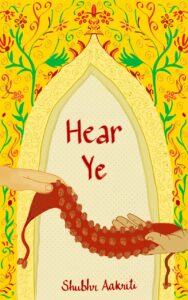
Another example, is Muses_Saga’s upcoming novel, Hear Ye. When the author, Tripti Jain, and I were discussing the cover, the idea that the ghungaroo, an important aspect of one of the main characters’ life, would be on the cover was a no-brainer. The fact that book is a love story just meant they had to be exchanged between the two protagonists.
But there are other ways for symbolism to be part of your book’s cover. Let us explore a few.
Use Symbolism
While we have covered symbolism in motifs. But let’s get back to it for a moment. Because other than motifs, you can use symbolism and abstract art to show a theme or an idea from the book. Think, the cover of Siya: A Suicide’s Argument. It is a woman on strings like a puppet. While not abstract, it shows the inherent idea of not being in control of your life that Siya feels throughout the book and works to change.
It sets the tone of the book and gives readers an idea of what to expect, which is an important task for a cover to accomplish.
And of course, the language of colours, both integral to the story and universe you have created, as well as those which have meaning in the “real” world is important. But before we got to that, we are going to look at what else a cover can be.
Go for a scene or a set of characters from the book
Just like the scene, you can also go for characters from a book, especially if they are in the middle of an important scene. Think cover of The Hobbit, with the scene where Bilbo is leaving for the adventure on the cover. Or Bilbo holding sting. The protagonist on the cover is always a crowd pleaser.
You can also use important settings from the book as the cover. An example, would be using the doors of Moria or Erebor as a cover for the Fellowship or the Ring or The Hobbit. Even better, using Bilbo’s green door as a cover for The Hobbit. These are all setting people have come to love because of the significance they hold in the story.
You can also use abstract art or just texts on a black of colour.
But what type of cover you create depends on a lot of factors. Trpti Jain weighs in with some considerations she has when making a book cover, apart from the author’s vision.
Genre of the book
While genre is more about marketing and shelving books, Tripti Jain says it is important when making a cover, to ensure you convey the right mood and vibes to the target audience. If you choose to go down this route, you can see what others book with similar ideas and genre have done. This can help you find your people who like the kind of books you right. And beyond the genre, the setting, time period, and such of the book, can also be incorporated into the cover to ensure the book lands in the right hands. For example, a fantasy set in pre-independence India can be easily conveyed by the cover showing something that is associated with British India. This allows those who enjoy books set in that time period to know yours is a book they would like.
But alongside the setting and genre, Tripti Jain, says another thing is important. The vibe of the book/
Mood of the text
The perfect example for this would be Siya: A Suicide’s Argument. The dark mood of the book, is conveyed by the muted and somber colours and strokes, which conveys to the readers the serious nature of the book. Tripti Jain also says that the colour scheme and typography should be in sync with the theme of the book, and we urge you to add the mood to it as well.
And it’s not just not only about what your cover looks like and what it conveys. There’s a lot more that goes into making one, especially if you are looking to create something eco-friendly. One aspect to making a book sustainable and the cover effective is the management of space. Extra and unnecessary space can be bad for aesthetic and as such wasteful, which is neither eco-friendly nor pretty. Therefore, it is essential to manage the space of your cover.
Managing white space and the spine
An important aspect of making a book cover, according to Tripti Jain, is deciding what to do with the spine and the white space on the cover. This is dependent on the size of the book, the theme, the thickness of the book, and what the author wants to convey through the language of graphics and art. For example, in Impulses Laid Bare by Alexia, there is a lot of white space on the cover. It works because the cover is mostly in black and white with a dash of color here and there to indicate that people have hidden sides to them.
For the spine, many authors choose to go with their name or the book’s name on it. It can also be left blank though, as many authors here at Muses_Saga choose to do. And of course, in a chapbook, this cannot be changed for the spine is rarely thick enough to hold anything.
Another thing to note, is that the spine and the title, even the subtitle of the book, if the book is sold digitally have an important role to plat in terms of SEO. So, we must look at them in terms of keywords.
Keywords
Tripti Jain says an artist needs to look at the keywords and we agree. Placing the art in such a manner
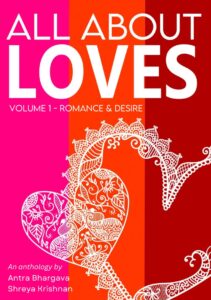
where the keywords are highlighted, and the font conveys not only the pacing and strength of the book, but also is legible is important. All this after all, played an important role in the making of the cover of Muses_Saga’s upcoming publication, All About Loves.
Choose a blurb
Another important aspect to communicate the story of your book and also capitalize on SEO is your blurb. To begin with choose whether you want reviews on the back cover of the book or a small summary telling your story. Do you want an author’s picture or bio?
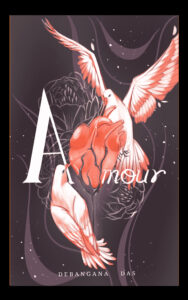
Readers generally prefer that there is a logline or a blurb telling you what the book is about…but if you feel SEO success using reviews from major publications serves you better, that’s your call. Or you can add art to the back cover as well, like Debangana Das and Andrilla Mitra did for Amor.
But it’s not just about the design and the text. For in a commercial book cover, you have to follow the word of the law as well.
Check the Legalities
Tripti Jain finally urges you to check with the legalities to ensure every piece you are using is in the public domain and none of the ideas are patented. This also helps us ensure important items like the ISBN and barcode are present on the back of the cover in the right manner, in my opinion.
This step is especially important as we don’t want a book banned because of its cover now do we?
Editing is to a book what polish is to jewellery. It takes what is a raw bleeding core and helps turn it into a work of art that’ll delight for generations.
But bestie, here’s the thing. Not all of us can afford editors.
And even those of us who can, well, we won’t give our editors drafts with grammar errors, will we? We want to give them a work that is as close as to the vision in our heads so that they can magic it into being.
Grandiose flowery words aside, what we are trying to say here, is that you need to edit your final draft before showing it an editor. Once you have your plot straightened out and are satisfied with the way your characters wrestled your story into submission, it is time to do some fine tuning.
And today, we are going to share a technique for fine tuning your dialogue. Other than getting beta reader to read your story and tear it apart, of course.
How Can Table Reading Fine Tune Your Dialogue
What is table reading?
Isn’t that a technique for scriptwriting?
Well, yes. It is a technique for scriptwriting. Essentially, it is the act of sitting around a table and reading your dialogue (alongside other parts) to see which drags and what sounds realistic and so on.
And once you have figured out which parts needs improvement, you can go back to the writers’ room and get editing. With each reading, your novel gets crisper, your dialogue sharper, and your setting more vivid.
See how a scriptwriting technique can help your novel?
And if you want to make it fun, you can pretend it is a D&D style table top adventure that your characters are on. You just have scripts instead of die.
Sounds fun, doesn’t it?
Will you try table reading for your next book? Let us know in the comments!
Maybe you are a writer. Or perhaps a publisher. If you are here, you are probably also an environmentalist, constantly wondering what you can do to make your hobbies even more planet-friendly. One way you can achieve your goal is by reducing waste. For writers and publishers, paper waste can accumulate over the years and while it may be unavoidable, it can be reduced. In this blog, we are going to look at how to reduce paper waste in the writing, publishing, and selling of a book. But first, let’s understand why that is important.
Why it is Necessary to Reduce Paper Waste
As we have mentioned, reducing paper waste is important because writers and publishers can become significant contributors to paper going to landfills. But isn’t paper biodegradable, you say? Then, why is it a problem if it goes to landfills? It’ll eventually degrade.
However, that isn’t how it works.
Landfills are full of waste, both biodegradable and not. Thus when paper goes to landfills, it releases methane, which is a greenhouse gas and contributes to global warming. That isn’t the only reason to reduce paper waste though. Let’s take a look at some of the others.
Deforestation
Paper production contributes to deforestation. After all, paper is made from trees and trees need to be felled for paper to be made. While paper production can be done sustainably, look for books with the FSC logo. These are made on sustainably sourced paper. No one can deny that paper production is a significant contributor to deforestation. 42% of all global wood harvest is used to make paper.
The good news is, however, that many companies have started to make paper from waste wood, , which is a resourceful and sustainable thing to do.
Monoculture Farming
In some areas, trees are grown for the production of paper alone. If paper production is economically viable then why would anyone bother to grow other crops on the same farm? While this does not happen everywhere, agro-farming is popular in India, paper production can lead to monoculture farming.
Now we know paper can be unsustainable. And we know, waste is always unsustainable. So what do we do? Try to reduce paper waste of course!
How to Reduce Paper Waste
There are several ways to reduce paper, which include unnecessary testing. However, those practices might be important to ensure the quality of a book. If done, these tests must be done sustainably, using eco-friendly paper and disposed of in an environmentally friendly and ethical manner. Here are some ways you can reduce paper waste in producing your book.
Take Online Submissions When Possible
While not everyone has access to computers and thus some submissions will be made offline, most publishers have now shifted to online submissions of synopsis and excerpts.
Proofread the Books Online When Possible
While some authors and editors are more comfortable editing on paper, if you can do it online, it would save a lot of paper. If you must use paper, then sustainably sourced paper and recycled paper are both eco-friendly options.
Do not waste paper when writing and editing
It is a common joke that writers ball up and throw away a lot of paper. While writing using pen and paper will result in paper that is discarded due to the material being discarded, it is better to give that paper for recycling instead of throwing it away. Furthermore, you can write online when possible. Editing too requires a change in the form you reading, at times. Thus, many editors and writers print on paper when editing. This can be made more sustainable by using recycled paper, printing on both sides or using FSC-certified paper.
Support Muses_Saga and your sustainable writing journey with recycled paper.
Have a Pre-Order or a Digital First Option
Imagine this, you print hundreds of copies of a book, and only a few sell. Wouldn’t that be a waste of resources and money? And what will happen to the books next? Either the bookstores will tear and pulp them or worse, they will be sent to landfills to make space for newer books. One way to avoid this is to have a pre-order system. There, you can see whether there is demand for a particular book or not.
Another way to avoid this waste of resources, money, and books, is to have a digital-first option, where readers can buy a digital copy of a book. This too helps you ensure that when paperbacks and hardcovers are launched, there will be a demand for them.
Produce Books on Demand
Another thing you can do to reduce unnecessary books that are printed but never find a home is to print books on demand. In this system, a book is printed only when a buyer requests a copy. This reduces waste and saves resources. There is also a financial opportunity here if you can personalize each copy of the book.
Use Minimal Packaging or Reused Packaging
Packaging makes up around 10% of a product. Thus using eco-friendly packaging can be a significant contribution to reducing waste, both plastic and paper. While paper packaging is more eco-friendly than plastic packaging, paper production still contributes to deforestation, waste, and monoculture. Thus, reducing the amount of cardboard and paper used, or reusing packaging is a great waste to combat these issues.
Size the Book Right
Another thing you can do is size your book right. If you use standard sizes, then you eliminate unnecessary paper cutting which reduces the scraps of paper that are left to go to the landfill. If these scraps must happen, then it is best to reuse or recycle them.
Design to Eliminate Unnecessary White Space
Designing is an important part of the publishing process, especially typesetting. While we must not sacrifice readability, we can design our books in a manner where there is the least amount of unnecessary white space. This will conserve paper and reduce the amount of paper that needs to be cut to be put in the book. This will eventually eliminate paper scraps.
Do not print unnecessary emails or covers
Many publishing houses print several editions of a cover to see how it looks on a book. While necessary, we should reduce the number of cover copies we print when possible.
Unnecessary copies printed of books, not for testing purposes, but to occupy space, and unnecessary printing of emails can waste paper. If such testing or documentation is necessary, sustainable paper can be used to reduce its impact. It is also important to ensure that the waste paper generated in testing, and such are sent to a recycling facility or reused.
A Parting Note
Reducing paper waste is important for a myriad of reasons. Muses_Saga aims to do just that. We hope to help others do the same. From using recycled paper to ensuring the paper you use ends up in recycling there are several options. As writers and publishers, we can digitize the process as much as possible, but that comes with its own sustainability pitfalls, as the internet uses a huge amount of energy.
Thus, we at Muses_Saga follow the ideology of imperfect sustainable living, where we do the best we can for the planet. What it means for us is using recycled paper and sustainable servors. For someone else, it can mean using FSC-sourced paper. Yet another might be completely digital with renewable servors. The options are endless for the companies that mindfully aim to reduce as much of their impact as they possibly can. You won’t leave a mark on the planet but on the people with your efforts.
Let us know in the comments if we have missed any way to reduce paper waste and save our planet a little every day. If you want to publish an eco-friendly book, we have the resources for you just a click away.
How to Make Financially Viable Eco-Friendly Paperbacks
Author- Anjali Roongta
When someone mentions sustainability, we think they are talking about the environment alone. However, sustainability is multi-faceted and involves environmental, social, and financial aspects. To cater to customer demands, publishers are going green. Yet how are we to make affordable eco-friendly paperbacks if the raw materials themselves cost more than a non-sustainable series? Are paperbacks about to become a thing of the past? Will they be unable to keep up with the sustainability requirements of the eco-conscious writer and reader? Also consider, they have to compete with piracy and cheaper digital copies. Fear not, for there may be ways to make sustainable paperbacks that are affordable. To their target audience at least.
In our previous blog, we covered how publishers could make eco-friendly books. We also shared how they could encourage sustainable reading and writing. In this one, we cover how publishers can make those practices affordable.
While theoretically, eco-friendly books made on recycled paper should be cheaper to make, the reality is different. Due to the need for more labor and the processing involved, recycled paper usually costs more than virgin paper. Furthermore, PoD, or Print-on-Demand services, increases the cost of printing a copy. This is without trying to include eco-inks . While making a completely eco-friendly book is not impossible, as proved by Tara Books, it can be difficult to make it affordable to the masses. Muses_Saga is on a mission to do just that. We provide eco-friendly books at no cost to people or the planet, through our sustainable online reading program. E-books are also easy to price in an affordable manner as there are fewer resources and labour involved in the making of one. The cost of shipping is also nil in the case of e-books.
The question then remains, how do we make sustainable paperbacks and hardcovers that are also economical?
Tips for Making Financially Sustainable Eco-Friendly Paperbacks
· Know your fixed costs-
Knowledge of the costs that you have to cover no matter, whether you publish a book or not, is essential when making a financial plan. And unless you have a financial plan, you won’t be able to make long-term decisions. You might price products wrong. Or not know how many products you need to sell a month to keep your business afloat.
· Look for alternatives-
While it might not seem like it, there are several vendors with sustainable products and services. Therefore, it is imperative for you to find vendors who can provide the value you need for your work within a budget you can afford. Do remember, paying a fair wage is part of being sustainable too.
· Give the customer value-
Perhaps it is time the paperback industry changes. We mass-produced paperbacks to make them cheaper. So perhaps a sustainable paperback has to be a personalized experience.
· Scale your business-
There is a reason mass production worked. It reduces the price of making one book. If there is a way you can produce books without increasing waste and washing resources, then scaling your business is a good idea. You can donate books that aren’t bought to libraries for one instead of pulping them. It might decrease your profit margins, however, so it isn’t the perfect solution- if we can consider it a solution at all.
· Education and awareness:
Providing information on sustainable publishing can help authors and readers understand their impact. It also communicates to them their power. This can result in them making more informed decisions and buying more eco-friendly books.
· Green procurement:
Encouraging authors, and readers to consider the environment when making decisions can help. As a publisher, you can make it easy for readers to choose sustainable options by labeling them. Extra coupons and discounts could be provided, if economical, for eco-friendly products. Or they could be personalized products.
The paperback industry is at an impasse- how to make eco-friendly books that are affordable without sacrificing so much profit that the whole production needs to shut down thus affecting hundreds of livelihoods in a negative manner. It is time for a change. Follow our blogs to see how to make ethical, eco-friendly, and financially viable books aka, the publishers’ guide to sustainable paperbacks.
Support your skin and Muses_Saga with this vegan and eco-friendly body butter.
Consumer awareness of environmental sustainability is increasing. This is forcing industries all over the world to promote their products as “green”. Are you a publisher who’s scared that unless they are able to make their company more sustainable, writers will abandon them?
Well, stop catastrophizing. There is a solution. Make eco-friendly and sustainable books. How you ask? Well, read on.
The pulp and paper industry is responsible for deforestation, an increase in waste, and the contamination of waterways. It also contributes to at least 2% of global carbon emissions. It reached a historic high in 2021. Hence, consumers are rallying. Thus, now, print-on-demand technologies and recycled paper are everywhere in publishing. Supply chains are under scrutiny too. Readers and authors demand eco-friendly books.
At Muses_ Saga, environmental sustainability is of paramount importance. We have introduced several practices to make our books both affordable and sustainable. With this blog, we extend that knowledge to other publishers on how to increase eco-friendly practices in their businesses.
Provide Print-on-Demand Services:
PoD reduces the number of unwanted books printed. Unwanted books often end up in landfills. Or worse they remain unread on bookshelves until they are torn and pulped. Not only is this disrespectful to books, but it is also wasteful. Hence, do the planet a favor and only print books that are sure to find a home. Publishers that are committed to PoD services include NotionPress and Muses_Saga.
Using eco-inks:
Petroleum-based inks are bad for the planet and human health. Our research and work with industry professionals show that at the moment it is not truly possible to make a small number of books using eco-inks. However, it is not impossible either. This is especially true for publishers who print large orders of books. Tara Books uses eco-inks.
Having sustainable supply chains:
From ethical and eco-friendly sourcing of paper and ink to a sustainable delivery system, a sustainable supply chain is an invaluable part of making an eco-friendly company. Having printers in multiple cities, as NotionPress does, can reduce the emissions from transportation too.
Not using plastic for lamination or packaging:
Reducing the use of plastic, especially new plastic or single-use plastic, is an important step in reducing plastic pollution. Therefore, water-based tape, paper packaging, and re-used or reusable and recyclable packaging are all good ideas. A cover made of a durable and recyclable material is a great option too.
Encouraging recycling and repurposing of books:
This reduces the environmental impact of disposal. However, it is better to donate or re-sell the books. As a publisher, you can also donate unsold copies of books to libraries.
Supporting Climate-Fiction:
Climate Fiction is an emerging genre. Thus, publishing fiction and non-fiction work around themes of climate change could be a smart move. It can spread awareness and build a profitable brand image.
Use a digital proofing process:
Before printing, use a digital proofing process to catch any errors and make the required changes. This can help reduce the need for multiple print runs which in turn reduces waste.
Encourage readers and writers to buy sustainable books:
We will cover more on this in our next blog on financing sustainable books, but you can encourage readers and writers to make more sustainable choices by personalizing sustainable books and providing certifications or labels to show they are sustainable.
Choose a sustainable printer:
Look for a printer that uses eco-friendly practices such as vegetable-based inks, recycled paper, or energy-efficient equipment.
Use recycled, sustainably sourced, tree-free, or reused paper:
Start your recycled paper publishing journey and support Muses_Saga in the same go. Get your Receipt Recycled Paper here.
Many publishers are now using sustainably sourced FSC-certified paper. Others are committing to using a portion of recycled paper. Muses_Saga uses 100% recycled paper but there are other options too such as BlueCat’s sustainable handmade tree-free paper. Keep in mind though, that printing on handmade paper can be difficult.
Use Chlorine-Free Paper:
While aesthetics are important, they are not more important than human health. Thus using chlorine-free paper is a good way to go. Where is chlorine used in paper you ask? For bleaching them white of course.
A Parting Note
Remember, being sustainable increases the chances of your publishing business doing better in the long term. And thus, to survive as a small upcoming publishing house, you need to cater to the demands of readers and writers. One such demand is eco-friendliness.
Are the ways we mentioned the only ways to create a sustainable publishing house? No. These are the ways you can create an eco-friendly publishing house. Financial and social sustainability is yet to be seen. To learn more about those aspects of sustainable publishing, and the how to battle challenges faced by publishers trying to go green return next week for our blog.
Support Muses_Saga as you take your things to school and work everyday. Get this upcycled bag today.Support Muses_Saga and your dry hands with GiftGreen India’s Vegan Lotion Bar
Tools Used Grammarly ChatGpt Hemmingway App Yoast SEO