Month: January 2023

  • Are E-books Truly The Most Sustainable Option?

    Imagine this- you get up craving a new book. You reach for your e-reader, buy the book, and sit down in the sun to read your new e-book, feeling great because you are one of the people who made a switch to a more sustainable future.

    Yet, if you are an occasional reader, this is not what will happen.
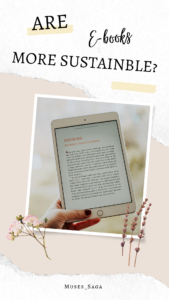
    What? E-readers might not be as sustainable as they told us they are. What a surprise. No, not really.

    Here’s the tea- e-books are more sustainable than paperbacks if you are someone who adores reading and reads 20+ books in a year.

    However, what of those of us who read occasionally? Well, we will be unable to set off the impact of that new e-reader. At least not without a lot of e-books.  Here’s why.

    The impact of paperbacks is relatively well-known today. Yet let’s reiterate it in short. Cutting down trees, taking up more space in transportation, and the chemicals used to bind ink and paper all have a negative impact on the planet. Furthermore, if the books end up in landfills instead of being recycled, they add to their negative environmental impact. So does that mean e-books are more sustainable because they eradicate these problems?

    The Impact of E-Books

    E-books are more sustainable. That would be an easy assumption to make, but a false one. We all tend to think of the internet as a wide nebulous space but it isn’t like that. The data we see on the net is stored in data centers which has an impact. They use electricity to stay cool, for one. This electricity can come from fossil fuels. The same goes for the electricity used to charge our e-readers. And while e-readers, produce fewer emissions during transport, they are made of natural minerals such as cobalt, copper, and lithium. A single e-reader takes about 33 pounds of minerals to make. Experts say that mineral extraction and refining has a wide range of environmental impacts. These include mining wastes, water contamination, and air pollution from smelting.

    It is estimated that producing one e-reader uses around 100 kilowatt hours of fossil fuels. It also uses 79 gallons of water. Emissions? 66 pounds of carbon dioxide.

    So what do we do? Stop reading? Because both paperbacks and e-books have an environmental footprint. This is without considering the impact of blue light on human health and the conditions of workers in e-reader manufacturing factories.

    Are other digital reading options a solution? Audiobooks? Reading online?

    Audiobooks and digital reading can be enjoyed on the same device as the one you use for work or other purposes, which would make them more sustainable than an e-reader that can only be used to read books. However, they still require natural resources to make. The blue light emitted from them has an impact on human health. Plus, while the recycling of electronic products is gaining ground, it is not yet mainstream.

    Which returns us to our original dilemma- how do we read sustainably? Because no one can deny how important reading is to human beings. From helping us learn a language to building empathy, both fiction and non-fiction play critical roles in our lives, after all.

    So what’s the solution?

    The answer lies in our reading habits. While e-readers can have multiple books thereby reducing their impact, their shelf-life is of three years, compared to a book which if taken care of can become a family heirloom. Furthermore, using recycled paper, print-on-demand technology, proper disposal, and eco-inks can reduce the impact of a book tremendously. Thus, depending on how much you read, either can be the more sustainable option.

    If you are an occasional reader, ditch the e-book and pick up a library card or a recycled paperback of a book you love and will surely read again and again. Mike Berners-Lee, a professor of practice in Lancaster University’s Environment Centre, wrote in a post for New Scientist that a reader must go through at least 36 paperbacks that can be recycled to even-out an e-reader’s footprint.

    Second, you need to do what suits your lifestyle for that will be the long-term change that creates an impact.

     Third, proper disposal of your e-reader or book is critical as anything that ends up in a landfill is bad for the environment. Therefore recycling or donating or even re-selling books and e-readers you no longer want or need is a good idea.

    However, the most sustainable option for the occasional reader remains libraries and sharing recycled paperbacks. Even reading online for too long can have health repercussions. Reading borrowed or second-hand books reduces the environmental impact of books significantly, whether they be paperbacks or in an electronic format.

    Therefore, a book that can be read by multiple people multiple times for years on an end is the most sustainable option, no matter how many you read in a year, but especially if you read less than twenty books annually.

    Scared that your reading habits go against your sustainable living ethics? Well, go on get a library card or find a eco-friendly online reading website.

    Updated- 20/11/2023

    Liked what you read? You can support Muses_Saga’s free online reading initiative by buying our team a book.
  • The Rise of Free Online Reading


    12 Best Sites To Read Free Books Online And Download Legally In 2019


    You may not have to pay to read books and stories ever again! Do you think it is repugnant to pay for digital copies of your favourite book? Well, now you may not have to pay for reading at all. Yes, you read that right- Muses_Saga offers free online reading. As do several other reading platforms.

    But, how does that work, you may ask? To answer that, let us look at the modern publishing industry with its long and storied history.


    The History of Publishing


    A novel idea


    Publishing began with printing. Publishing books for mass entertainment, though, came into being in the 19th century. Newspapers with serialized stories sold like hot cakes. Penny Dreadfuls ruled the market.

    Then, novels came into being. This was due to an emerging middle class who had time to read for entertainment. The change was in, and it would shape the industry we know today, as much as the internet would later.


    Hello World

    Don’t we all love the internet? We love to hate it, but we still have to admit that it changed the world. The 20th and early 21st centuries with their digital boom made it possible to publish and distribute books electronically. This led to the proliferation of e-books and other digital content. Most of this content was significantly cheaper than paperbacks.

    However, many people still distrusted online shopping for e-books. They felt they should not be paying for a digital copy of a work, a sentiment prevalent even today. This will play an increasingly crucial role later on when free online reading comes into the picture. Before that, though, let’s look at self-publishing.


    DIY

    Traditional publishers have a hold on the publishing market. They would choose whose work was shared with the masses and who was rejected. To combat this, many writers began editing their own work, making covers, and marketing and distributing their own books. While quite a few people looked down upon self-publishing as a low-quality product, that was not true in the slightest.

    Many traditional publishers reject writers for not having an audience, being first-time authors, or writing in non-profitable genres. Self-publishing not only gives writers creative control over their work back, but it also removes these hurdles. Today, self-publishing houses have become their own brand of publishing houses.


    What now?

    Now, there is another change happening in the world of books and stories. The rise of affiliate marketing and paid advertising gave birth to blogging. Blogging websites had stories that were eventually published as e-books and paperbacks. Some of the blogs were simply read as blogs. Blogs became a significant source of income for writers and content creators. Remember serialized newspaper stories? Sound similar?

    In the end, all these factors came together and the publishing industry came full circle. This happened due to the rise of free online reading. This no-cost online reading is what will ensure you do not have to pay for books again.

    Free online reading is when a reader can read a work on electronic platforms for zero cost. These platforms range from blogs to reading websites such as Wattpad and The Daily Reader. In most cases, the reader does not have to pay a penny. Though, in some scenarios, these websites have a paid ad-free model. Some publishers and authors charge a premium for certain books. Other websites only offer a portion of the book for free. Thus, you can see that the no-charge online reading business model is diverse. Additionally, this diversity does not factor in how you can read short stories and poetry on social media.

    So why would you pay for books when so many are available to read for free? You might say, but Anjali, this phenomenon might not last. To that, I say, zero-cost reading is likely here to stay. Now you might argue that publishers will fight against it but let me tell you how that might not be the case. This business model can be a powerful tool for publishers after all. When they offer some books for free, they can use that to build a brand image and reach new audiences. This will help them increase both visibility and the sale of books they do charge a fee for. Let’s dive deeper into no-cost reading and its impact on publishing.


    Impact of Free Online Reading

    This rise of free online reading can have several impacts on the publishing industry. One example is the rise of “freemium” business models. In this model, as you have already read, readers get some of the work for no charge. The free sample could consist of a selection of books or a percentage of the entire work. This allows publishers to monetize certain works while also building a loyal customer base. It also raises awareness of their brand. It’s a win-win for everyone involved.

    Another potential impact of no-cost online reading will be on how books are marketed. As more and more of you, the readers, turn to free content, publishers will need to use this content as advertisements for their paid content. Thus, marketing and promotion of free content will become paramount to getting more eyes on paid content.

    Free online reading also solves the problem of you not wanting to pay for digital content. Now if you want to own a copy of a work you are hooked to, you may buy it. Sampling the work, though, remains free. Isn’t that delectable?

    The best part? As the work is free, you will be able to give new work a shot without fear of wasting money. Hence, more upcoming writers will get the visibility they deserve.

    So you can see that, as always, the publishing and reading business is changing. Boy, are we here for it. Like always, technological advancements, your interests, and changing business models will all have an effect on the industry and the trends that emerge. What do you think of the latest trend of free online reading? Will it last or soon be “last-season” and we will be back to paying for stories to read?

    Liked what you read? You can support Muses_Saga by sharing, or buying our team a book.